
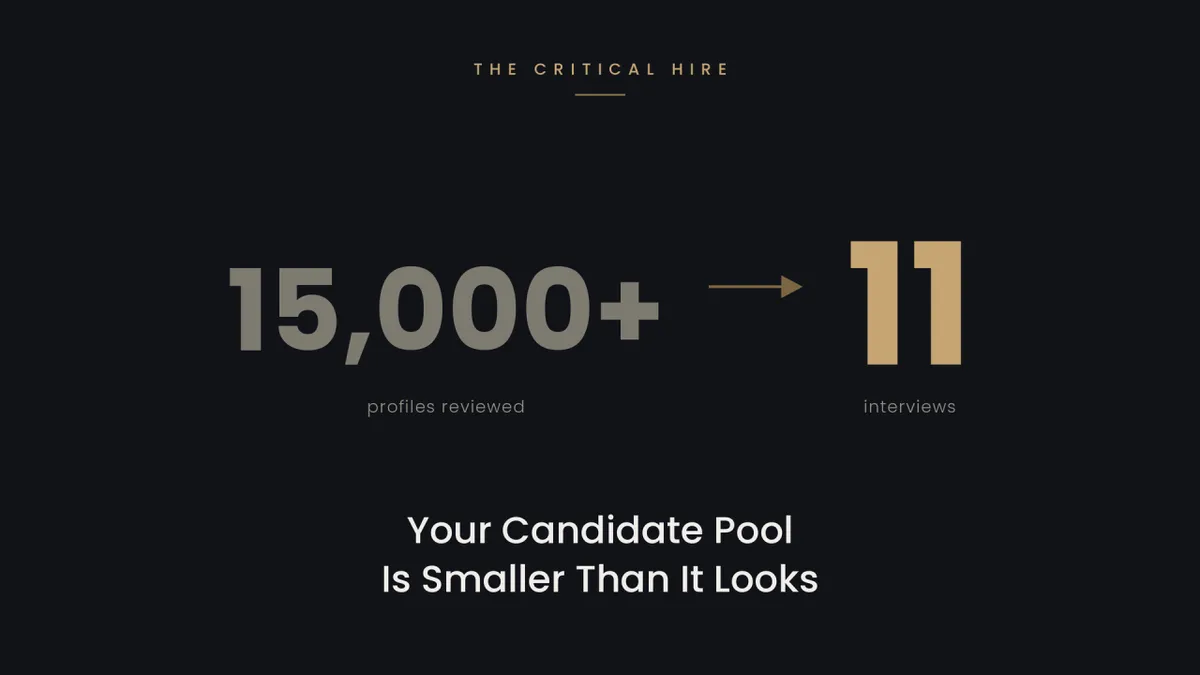
Your Candidate Pool Is Smaller Than It Looks
Last month I wrote about the homework that has to happen before any outreach goes out. This month is about what comes back once it does.
On one search this year I looked at more than 15,000 profiles. About 1,400 of them were worth saving, meaning they looked like a real possibility on paper. A little over 1,000 of those got a message, and about 250 people wrote back; 11 made it to an interview.
Most hiring leaders who see numbers like that assume the search went wrong somewhere. They figure the keywords were off, or the outreach was weak, or somebody didn't put in the effort. None of that happened. Those numbers are what a search looks like once the pool has been tested against what the job actually requires, and I want to walk through why.
A title is not a market
The job title on that search had thousands of people behind it, and from the outside that looks like a big market. It isn't one. A title is just a category, like "manager" or "engineer." The business had one specific problem to solve, and the people who have actually solved that exact problem before are a much smaller group than the people who happen to carry the title.
Here is why that matters. Two people can hold the same title and do completely different work. One of them has spent years keeping something running that was already built before they got there. The other one built it from nothing. Both of them are good at what they do, but only one of them is the right hire for a given company, and the job description almost never tells you which one, because job descriptions list duties, not the problem the company is trying to fix.
Every requirement costs you people
Nothing the client asked for on that search was unreasonable, and that is exactly what makes the math sneaky.
They wanted someone in a specific experience range rather than anyone above a minimum. That was the right call, because a role built for someone earlier in their career usually isn't a good fit for a person with thirty years behind them. The pay, the scope, and the growth path are all sized for a different stage of life. But it also means a large share of the people who carry the title are out before the search even starts, because most of the people with that title have been doing it a long time.
They also needed someone who could be in the office five days a week. That is one short sentence in a job description, and it quietly removes a long list of names, for a simple reason. A big share of the people in any field now work remote or hybrid, and many of them won't give that up. Anyone who lives more than a reasonable drive away is out unless they are willing to move, and most people are not. So the pool shrinks to whoever already lives nearby and is fine being in the building every day.
Then there is the question of who is actually available. Most strong people are not looking for a job, because they are employed, they are doing well, and nobody is pushing them out the door. That is the entire reason passive search exists. Somebody has to go find them and give them a reason to listen. But it also means the real yield from any list is only a fraction of its length, because most of the people on it are happy where they are and will say no, or say nothing.
The last filter is whether the person fits the actual problem, which goes back to the first section. This one cuts the deepest, because it is the difference between someone who has done the job and someone who has done this job. It is also the one that gets measured the least, because it doesn't show up as a keyword or a years-of-experience number. You only find it by reading the profile closely and talking to the person.
Each of those requirements is fair on its own. The problem is that they don't add up, they multiply. If each filter keeps half the people, four filters together don't keep half. They keep one in sixteen. That is how 15,000 profiles became 1,400, then 1,000, then 250, and then 11.
Count the replies
This is the part most searches miss, because nobody is keeping score of what the people who said no actually said.
About 250 people wrote back on that search, and 43 of them said pay was the reason they passed. They weren't negotiating with me. They were declining.
One person saying the money doesn't work is a preference. Maybe they are overpaid where they are, or maybe they just want more. 43 people saying it on their own, without ever comparing notes, is a pattern, and a pattern is information about the market. It tells you where the real price of that skill set sits right now, in that location, for that kind of role. The worst thing I can do with that information is sit on it and keep sending messages, because more messages won't change what the market is telling me.
How I handle it
I take the count to the client early, with the replies behind it. I don't present it as a claim about what the market pays, because my opinion isn't the point. I present it as a straight report of what qualified people said when I asked them to make a move.
That is a very different conversation than "give it more time." Give it more time means we keep doing what isn't working and hope. A report of what 43 people said gives the client something to decide on. They can raise the number, they can loosen a requirement, they can rethink the location, or they can decide to wait. Any of those is a decision, and a decision is what unsticks a search.
How to get it right
You don't need 15,000 profiles to learn any of this. You need three honest answers before the first message goes out.
The first is what problem this person is being hired to solve. Not the title, but the actual problem. That is what tells you which of the two people with the same title you are looking for.
The second is how many people clear every requirement, and how many of those would actually make a move for it. That is the real size of your pool, and it is almost always smaller than the number of people with the title.
The third is what gives first if that number turns out smaller than you hoped. Pay, experience, location, or timeline. Something usually has to, and it is far easier to decide that at the start than after months of looking.
Answer those questions in week one and the adjustments are easy. Answer them three months in and every option feels like a concession, because by then the role has been open long enough that everyone is tired of it.
A recruiter's value isn't measured by how many resumes land in your inbox. It is measured by the quality of the search and the honesty of what comes back from it. Sometimes the most useful thing I can hand a client isn't a candidate at all. It is what 250 people told me.
Your candidate pool is always smaller than it looks. The only question is whether you find that out in week one or halfway through the search.
Steven Nelson, Senior Recruiter and Director of Business Development, Corporate Connections LLC. The Critical Hire comes out monthly with practical notes for hiring leaders on executive and professional search.
What is one requirement you would never compromise on, and how much of the pool do you think it costs you?
Previous edition: We Don't Have a Plant


